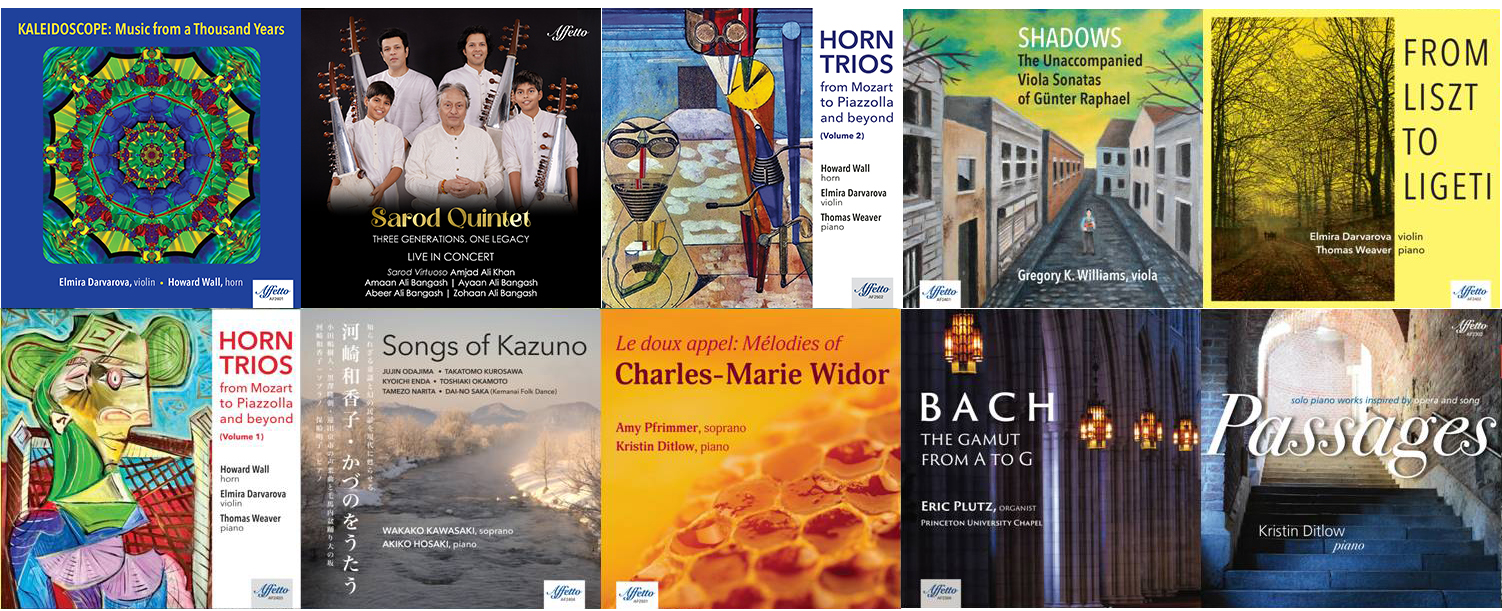
KALEIDOSCOPE: Music from a Thousand Years from Elmira Darvarova, violin and Howard Wall, horn

Like gazing into a kaleidoscope, this double-CD album brings a treasure-trove of musical miniatures tracing the sweeping panorama and historic perspective of 10 centuries.

This charismatic retrospective is a fascinating collection, brimming with world-premiere recordings (50 out of 51 tracks) and presenting a stunning variety of compositions – some original, some arranged by the performing artists – violinist Elmira Darvarova (first and to date still only ever, woman- concertmaster of the Metropolitan Opera Orchestra) and hornist Howard Wall (a former long-time member of two of the world’s greatest orchestras – the New York Philharmonic,and the Philadelphia Orchestra).

The meticulous album notes cover the multi-dimensional, serendipitous and cross- pollinating nature of essential events and legacies, which endure and continue to fascinate and transport us.

PRE-ORDER AT:


Share : facebooktwittergoogle plus
pinterest

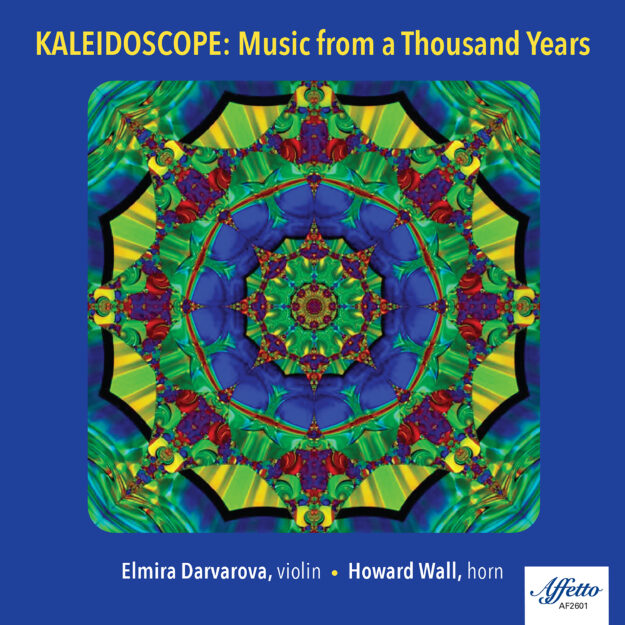
Sarod Quintet: Three Generations, One Legacy

Honoring India’s rich tradition of musical heritage, the Sarod Quintet brings together three generations from a legendary musical lineage. Representing the 6th, 7th, and 8th generations of an unbroken tradition, this unique ensemble features Sarod Grand Master Amjad Ali Khan,, his sons Amaan Ali Bangash and Ayaan Ali Bangash, and Ayaan’s 13-year-old twin sons, Zohaan and Abeer.

This special performance was recorded in the historic city of Kolkata in January 2025. They were accompained on Tablas by Satyajit Talwalkar and Anubrata Chatterjee.

AVAILABLE AT:
APPLE MUSIC | AMAZON | SPOTIFY


Share : facebooktwittergoogle plus
pinterest

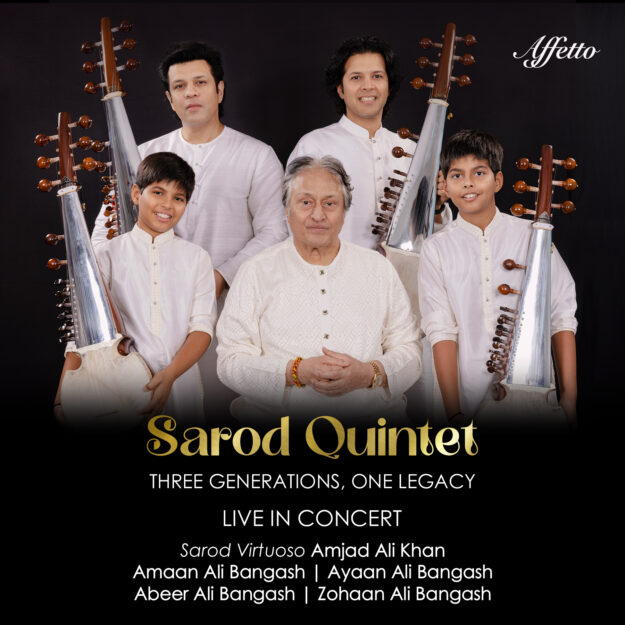
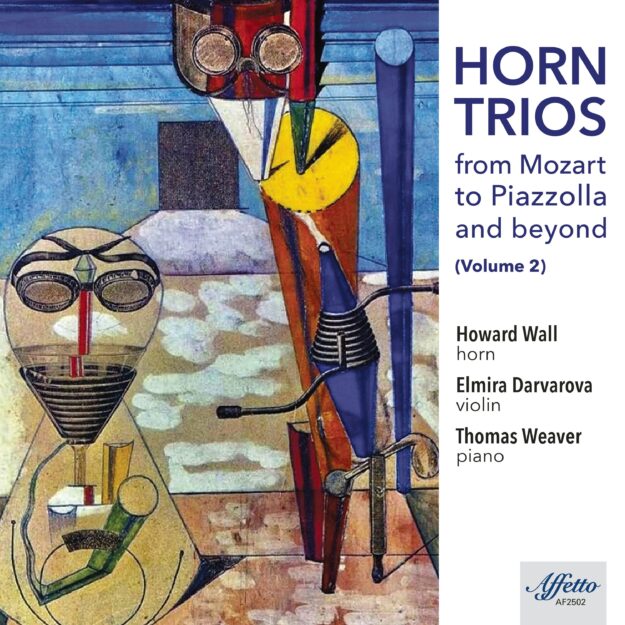
Horn Trios from Mozart to Piazzolla and Beyond, Vol. 2

HORN TRIOS from MOZART to PIAZZOLLA and beyond (Volume 2) is the second installment of a compendium of horn trios from the 18th, 19th, 20th and 21st centuries – an amazing “anthology” of original and arranged repertoire for the trio ensemble of horn, violin and piano. This is not the kind of recording project consisting of the “obligatory” Brahms Horn Trio in the company of 2 or 3 other much-recorded works. While the Brahms Trio is included (in Volume 1), the concept is a lot more ambitious. Presenting a 4-centuries, 2-volume collection where each album encompasses a double-disc compilation, the artists explore a strikingly-interesting array of diverse styles and genres, where even the sheer number of different nationalities of the composers (representing 12 different countries in Vol. 1 and 11 countries in Vol. 2) brings instant awe. In Volume 1 we heard trios by composers from the United States, Canada, England, Germany, Austria, France, Liechtenstein, Argentina, Estonia, Romania, Bulgaria and Morocco, while Volume 2 presents music by composers from the US, UK, Australia, Ukraine, Russia, Germany, Austria, France, Spain, Argentina and Czechia. Among the 15 works in Vol. 1 we heard 8 world-premiere recordings, while Vol. 2 is literally brimming with world-premieres: among the 13 works in Volume 2, there are 11 world-premiere recordings. The three artists offer breathtaking interpretations. Hornist Howard Wall, whose storied career includes not just his legendary reputation as a long-time member of two of America’s most prestigious orchestras – the New York Philharmonic and the Philadelphia Orchestra, but also an impressive discography of chamber and solo discs, brings a symphonic dimension to his own transcriptions of music by Piazzolla, Stravinsky, Bach and John Coltrane. Violinist Elmira Darvarova is equally “at home” in Mozart (as a former concertmaster of the Metropolitan Opera, where she accompanied the world’s greatest singers in a multitude of Mozart operas) and in Piazzolla (having attained a Grammy nomination for one of her many Piazzolla albums), as well as everywhere else (including world music, with her album based on Indian Ragas debuting as No. 3 on Billboard) and she possesses not just an incredibly strong and full tone, but also a magnificent level of sensitivity which fascinates with the limitless range of dynamics and sophisticated phrasing. Pianist Thomas Weaver, whose own horn trios (one in each volume) mesmerize with atmospheric moods, and whose translucently-textured playing has been hailed for his recent album of Hungarian composers (recorded together with Elmira Darvarova), shines in each piece with sublime virtuosity and fierce artistic commitment. This is a “not to be missed” album release, which has been eagerly anticipated in the “horn universe” and elsewhere, leaving open the possibility of a future Volume 3 as a conclusion to this terrific project.

AVAILABLE AT:
AMAZON | APPLE MUSIC | PRESTOMUSIC


Share : facebooktwittergoogle plus
pinterest

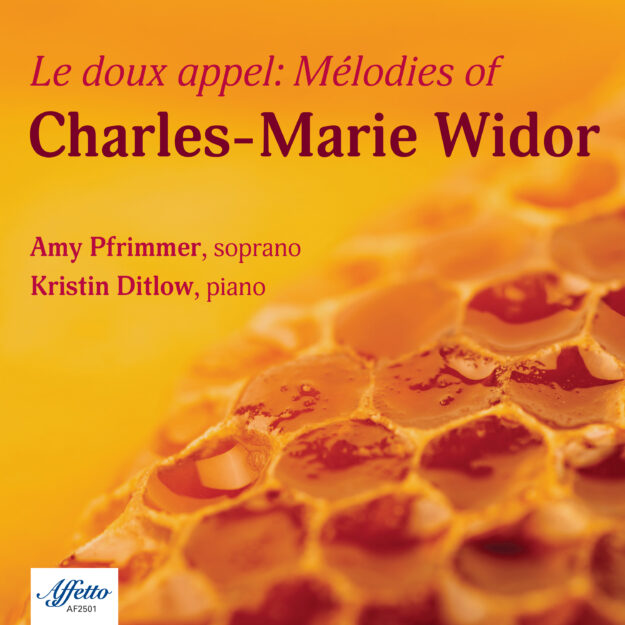
Le Doux Appel: Mélodies Of Charles – Marie Widor – Amy Pfrimmer, soprano; Kristin Ditlow, piano

Charles-Marie Widor (1844-1937), one of the most influential French organists of the late 19th and early 20th centuries, jokingly referred to himself as the substitute organist of the church of St. Sulpice, Paris, despite his 64-year tenure there. While best known for his ten organ symphonies, Widor composed in a wide variety of sacred and secular genres: chamber music, orchestral works, ballet, operatic music, works for piano, and most importantly for this recording, mélodies. In his day, Widor won respect as a composer, organist, professor, and cultural ambassador of France. In 1890 he became César Franck’s immediate successor as Professor of Organ at the Paris Conservatoire, and, in 1896, he succeeded Théodore Dubois as Conservatoire Professor of Composition. Widor’s students in organ and composition included such distinguished names as Marcel Dupré, Louis Vierne, Charles Tournemire, Darius Milhaud, Albert Schweitzer, and Edgard Varèse. Widor composed over 100 songs which have been overshadowed by his immensely popular organ works. His genius with melody, comprehensive piano writing, and discerning poetic text settings distinguish him as a gifted song composer unusually sensitive to the capabilities of the voice. Throughout his extensive career, Widor was concerned with achieving the best possible musical result in his compositions and continually developed, revised, and republished his works. A publishing custom of the time was to group sets of six songs in a single opus number; however, the songs of each of Widor’s sets are not necessarily related by poet or theme. The songs were not intended to be presented as a cohesive cycle. With that in mind, the songs in this recording are not presented by chronological opus numbers. Widor’s mélodies exhibit a wide variety of musical influences, from the works of the German lieder composers to French vocal genres, such as the bergerette and opéra lyrique. His songs range from straight-forward strophic settings to intricate through-composed forms. Widor’s harmonic language can find beauty in purely diatonic sonorities while others take advantage of the more remote modulations. Elements of Orientalism, popular in his day, color the exotic musical language and mood of several songs. Widor’s songs represent his quest for a perfect marriage of music and text. His mélodies feature the poetry of such beloved and respected literary figures as Victor Hugo, Théodore de Banville, René-François Sully-Prudhomme, Paul Bourget, and Pierre-Jules Théophile Gautier. Unlike many of his contemporaries, Widor – thrillingly – was inspired to include poems by women whose work he admired among his song settings. Some of them are contained in this album’s offerings. To quote Widor biographer John Near, “We experience very great charm when happy fortune permits us to hear a page of Mr. Widor, harmoniously vying with Victor Hugo, Sully Prudhomme, or Paul Bourget.”

AVAILABLE  AT:
AMAZON | SPOTIFY


Share : facebooktwittergoogle plus
pinterest

Songs Of Kazuno – Wakako Kawasaki, soprano; Akiko Hosaki, piano

This album represents a trove of new and never before recorded songs from the Kazuno region in northern Japan world premiere recordings. Many of the works by renowned local Kazuno children’s song composers were largely unknown with beautiful melodies, even though the Japanese culture reveres children’s songs, taught to children and sung often by both children and adults. The scores for these children’s songs were not published for commercial sale and were believed to be inaccessible but were lent to soprano Wakako Kawasaki by two individuals residing in Kazuno who possessed complete children’s songs collections of composers Jujin Odajima and Takatomo Kurosawa for this recording project, as these works of these great composers from Kazuno were not even being sung in their hometown. These collections were used as the base works for the album in addition  to pieces composed by Sapporo composer Kyoichi Enda, inspired by Japanese author Ryusuke Saito’s story of the Kazuno floods. The album also includes a revival performance of “Dainosaka,” a song associated with the Kemanai Bon Dance not sung since the early Showa period (1926-1989), arranged with piano accompaniment by Dr. Akiko Hosaki. Today “Dainosaka” is performed only with flute, drum, and dance, but historical records indicate it was accompanied by song as well. “Dojokko Funakko,” was discovered on an original song monument at a temple in Kazuno and added to the album. The album is the result of years of research and discussions with Japanese musicologists in order to create an collection which will be historical in the annals of Japanese music.

AVAILABLE  AT:
AMAZON | SPOTIFY


Share : facebooktwittergoogle plus
pinterest

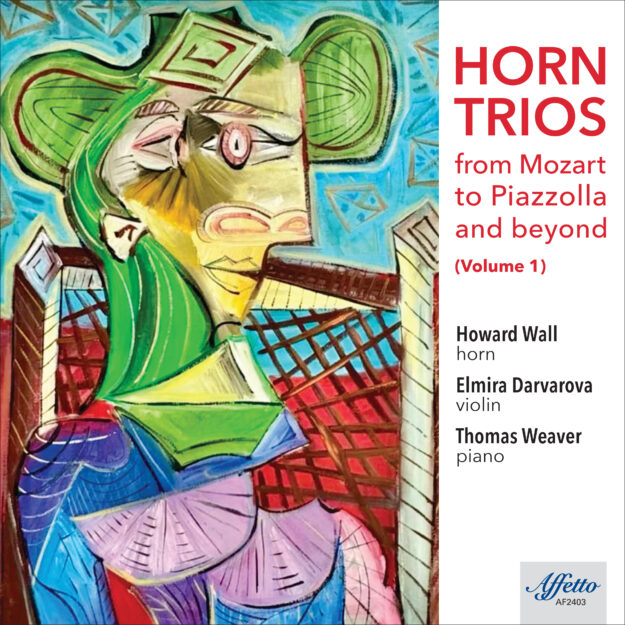
Horn Trios From Mozart To Piazzolla And Beyond (Volume 1) by Howard Wall, Elmira Darvarova & Thomas Weaver

HORN TRIOS from MOZART to PIAZZOLLA and beyond (Volume 1) is the first installment of a 2-volume compendium of horn trios from the 18th, 19th, 20th and 21st centuries – an amazing “anthology” of original and arranged repertoire for the trio ensemble of horn, violin and piano. This is not the kind of recording project consisting of the obligatory Brahms Trio Op. 40 in the company of two or three other much-recorded works. Presenting a 4-centuries double-disc album with just this First Volume, the artists explore a strikingly-interesting collection of diverse styles and genres, where even the sheer number of different nationalities of the composers (from 12 different countries) brings instant awe. Yes, the Brahms Horn Trio is included, as well as works by Mozart and Piazzolla (as the album’s title proclaims), but we also hear trios by composers from the United States, Canada, England, France, Liechtenstein, Estonia, Romania, Bulgaria and Morocco.
Presenting no less than 8 world-premiere recordings in just this Volume 1, the album brims with rarities and contrasts, showcasing many works written specifically for these artists. Hornist Howard Wall, whose storied career includes not just his legendary reputation as a long-time member of two of America’s most prestigious orchestras – The New York Philharmonic and The Philadelphia Orchestra, but has also produced an impressive discography of chamber and solo discs, brings a symphonic dimension to his own arrangement of Piazzolla’s “Oblivion”, and an excitingly-speedy rendition of the Brahms Trio, as well as breathtaking interpretations of all other works. Violinist Elmira Darvarova is equally “at home” in Mozart (as a former concertmaster of The Metropolitan Opera, where she accompanied the world’s greatest singers in a multitude of Mozart operas) and in Piazzolla (having attained a Grammy nomination for one of her many Piazzolla albums), as well as everywhere else, possessing not just an incredibly strong and full tone, but also a magnificent level of sensitivity which fascinates with the limitless range of dynamics and sophisticated phrasing. Pianist Thomas Weaver, whose own horn trio mesmerizes with atmospheric moods (and is narrated by himself, reading Edgar Allan Poe’s Stanzas) and whose translucentlytextured playing has been hailed for his recent album of Hungarian composers (recorded together with Elmira Darvarova), shines in each piece with sublime virtuosity and fierce artistic commitment. This is a
“not to be missed” album release, anticipating the upcoming Volume 2 which will conclude this terrific project.


Available at: AMAZON | APPLE | SPOTIFY

Share : facebooktwittergoogle plus
pinterest

1 2 3 9