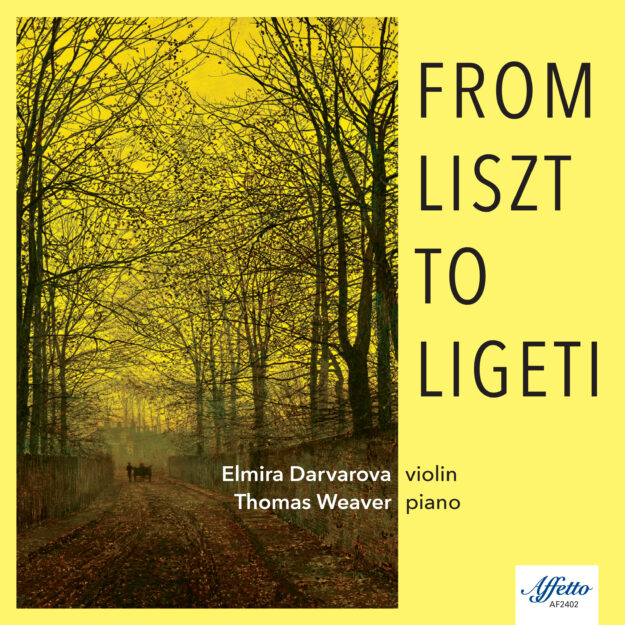
FROM LISZT TO LIGETI – Elmira Darvarova, violin & Thomas Weaver, piano
A spectacular tribute to Hungarian-born composers, from the brilliant, award-winning, performers — Grammy nominated violinist ELMIRA DARVAROVA (first and only woman-concertmaster of The Metropolitan Opera) and pianist THOMAS WEAVER (professor at Curtis Institute of Music), the album “FROM LISZT TO LIGETI” brings an exceptionally-vivid narrative linking historic milestones in the legacies of a number of superb Hungarian-born musicians — composers and performers, who have so enormously contributed to enriching the world’s cultural treasure-trove. Liszt, Joachim, Bartók, Kodály, Hubay, Goldmark, Ligeti — they have all bequeathed us masterpieces to behold and cherish, throughout several centuries of showcasing, shaping, preserving and amalgamating national traditions and global influences through the prism of their own personal creative gifts. This album is a charismatically kaleidoscopic retrospective which traces the historic perspective of how uniquely-innovative artists such as Bartók and Kodály, built the cornerstones of their oeuvre by exploring, embracing, critically analyzing and then re-shaping Liszt’s ideals, and how Ligeti followed on the heels of Bartók and Kodály with his own ethnomusicological research, to create, still in his student days, a little-known Duo that he kept editing and crystalizing throughout his life and throughout his own various periods of transforming and modernizing, but then later returning to, conventionally-established expressive means, and how Joachim — as a muse to numerous music giants, such as Brahms, Liszt, Dvorák, Bruch, Robert and Clara Schumann — influenced and caused cataclysmic events without which the history of music would not have been the same. In addition to the best-known Hungarian-born composers Liszt, Bartók, Kodály and Ligeti, the inclusion of Joachim in this album as a co-author (not just dedicatee) of Liszt’s “Hungarian Rhapsody No. 12” (in its version for violin and piano), makes sense historically not only because Joachim in his transcription radically transformed Liszt’s composition, but also because Joachim famously contributed to the creation of numerous gems by some of the greatest ever composers, such as: the violin concertos by Dvorák and Bruch (who published these works after Joachim helped in creating them) and Brahms’ First Piano Concerto (bearing Joachim’s hand-written corrections which elicited “thank-you” letters from Brahms, during the 4 years Brahms took to write that concerto). The inclusion in this album of the Hungarian-born composers Hubay and Goldmark is also well-justified, bringing up yet other interesting dimensions to the album’s narrative. The album’s deeply-considered collection explores the affecting lyrical gift of Goldmark, who, as the largely selftaught son of a synagogue cantor, followed his ingrained melodic instincts from growing up without riches among 20 siblings, to becoming Vienna’s leading composer (after the deaths of Brahms and Bruckner), teaching Sibelius and writing a mind-blowing violin concerto, a symphony championed by Sir Thomas Beecham and by Leonard Bernstein, and several operas, one of which was produced at The Metropolitan Opera in 1885, and three of which were presented in Vienna during Mahler’s leadership of the Court Theatre. Hubay’s unparalleled contribution as a historical “cross-roads” figure is also well-defined in this album, not only because of who he was — the son of an elite musician (who conducted the Budapest premiere of Wagner’s “Lohengrin”), a student of Joachim, a department head at Brussels’ Royal Conservatory (succeeding Vieuxtemps and Wieniawski), a chamber music partner of Liszt and of Brahms (performing with Brahms the world-premiere of Brahms’ D Minor Violin Sonata, and the world-premiere of Brahms’ Third Piano Trio), composer of numerous concertos, symphonies and operas (one of which was embroiled in a scandal reported 100 years ago by The New York Times), and the teacher of many illustrious star-violinists who became muses to Bartók, Kodály, Ravel, Holst, Vaughan Williams, Rebecca Clarke (among these violin prodigies were Bartók’s girlfriend Stefi Geyer, Eugene Ormandy of The Philadelphia Orchestra fame, and Joachim’s great nieces Jelly d’Arányi and Adila Fachiri, who not only inspired Bartók and many others, but also spear-headed the search for Schumann’s long-suppressed violin concerto, “cancelled” and hidden by its dedicatee — their great-uncle Joachim). The choice of Hubay’s well-known czardas “Hejre Kati” for inclusion in this album reflects the evolution and role of that genre in the history of Hungarian musical traditions — from the early roots of czardas stemming from verbunkos (used even by Haydn), to its controversial misappropriation by dilettante performers whose inflectional performing style was confused and misinterpreted by Liszt as original Hungarian folk melodies, to more tasteful artistically expressed concert-stage compositions (like Hubay’s “Hejre Kati”), to the eventual dethroning and demythologizing of the czardas by Bartók and Kodály, who discovered, revealed and incorporated the true authenticity of their home country’s original folk music. The album selections follow Bartók’s evolving from the student-composer of a traditionally-profiled, Romantically-influenced Andante and the mature creator of “15 Hungarian Peasant Songs” and “Rhapsody for Violin and Piano No.1” (embodying his scientific and artistic mission to reveal the exquisitely-uncontroverted authentic beauty of ancient folk melodies) to the transfigured innovator who elevated and transformed old rustic traditions, fusing them into new and progressive forms and rhythms, reaching out to impressionism and jazz (as depicted in Bartók’s “Dance in Bulgarian Rhythm No. 6”), and paving the way for Ligeti’s experimentalism, which, through multiple “back and forth” constructing and de-constructing,
reflected Ligeti’s never-ending search for artistic inspiration (this album presents the, recorded here only for the second time, recently-discovered Duo for Violin and Piano, which Ligeti never submitted for publication, but continued returning to, and working on.) The unusually-meticulous album notes cover the multi-dimensional, serendipitous and cross-pollinating nature of essential events and legacies, which endure and continue to fascinate us.
AVAILABLE AT:
Amazon | Apple | Spotify


 was a prolific and versatile composer from a musical family, but because his ... )



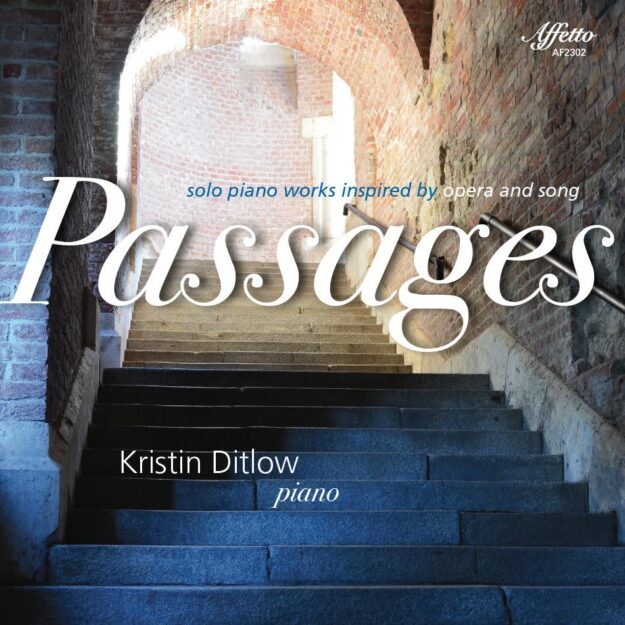 Composers are often tasked with creating from a void, an emptiness. The blank page is an easel. The parts of a structure of a piece of music – melody, accompaniment, line, harmony, tension, and release – must take shape to reach the listener’s ear. Sometimes, instead of starting with an empty sheet of staff paper, a composer creates something which is pollinated by another source. Perhaps it is a folk song, a poem, a melody, or an even larger work, such as a full-length opera. New works are then realized. In the case of this two-cd set, an East South African folk tune receives new life as a romantic piano ballade. A sonnet of Petrarch resurfaces centuries later as a dramatic declaration of love, through a solo piano work. The repertoire on these discs traces Kristin Ditlow’s own growth as a pianist and musician. Each work marks a chapter of her development and artistry to the present. The song transcriptions are pieces that have been played countless times with vocal partners: the operatic works are works that she has coached or conducted. Her passionate pursuit of travel is also a thread which weaves throughout the discs: the Samuel Coleridge-Taylor spiritual arrangements are works that she became acquainted with as a high school choral accompanist: meeting her husband while on tour in China in 2012: the Mongolian Shepherd Song is her arrangement of a traditional folksong from the Chinese Mongolian community, a work introduced to her by her husband in China originally for erhu and pipa (traditional Chinese instruments) accompaniment but transcribed for violin and piano. Kristin Ditlow has spent five summers performing, teaching, and coaching in Hungary and the Bartók selections all harken back to those times in the Hungarian countryside. Pianist, coach and conductor Dr. Kristin Ditlow dedicates her musical career to collaboration and connection. She has been seen in concert throughout North America, Mainland China, and Western Europe as a soloist, collaborative pianist, and conductor. The set of music pieces in this album is representative of her “Passages” in her career.